
Reviewed · WALKING TOURS
Best of Prague Private Walking Tour (Left and Right Riverbank)
Prague makes sense fast on this route. This private walking tour is built like a relaxed half-day orientation across Prague’s riverbanks, with a licensed local guide helping you connect neighborhoods instead of wandering in circles. You get a street-level intro to the city’s power centers, legends, and everyday life, with pacing that keeps you moving but never rushed.
I especially love the way the route balances big icons with human details, like Mozart’s church-organ story in Malá Strana and the Lennon Wall graffiti tribute. The second thing I like is the option to tailor the day to your interests since it’s private and guided, not a rigid checklist. The one real consideration is simple: it’s a lot of walking over uneven historic streets, so plan for shoes that can handle hours on foot, and expect some stops to be optional if you choose to pay for interiors.
In This Review
- Key points before you go
- Why This Left-and-Right Riverbanks Route Works for First-Timers
- Start Near Municipal House, Then Let Your Guide Set the Pace
- Prague Castle Complex: St Vitus, Power, and Views From the Hill
- Malá Strana and St Nicholas Church: Baroque Beauty Under the Castle
- Lennonova zeď: Graffiti That Became a Cultural Footnote
- Charles Bridge: Legends, Statues, and the Best River Views
- Klementinum: The Jesuit College and Prague’s Scholarly Side
- Pinkas Synagogue and Old-New Synagogue: Jewish Prague in Two Powerful Stops
- Old Town Square and the Astronomical Clock: Prague’s Stage
- Estates Theatre, Charles University, and Wenceslas Square in One Flow
- Powder Gate and the Municipal House: Gateways to the Medieval Royal Route
- Practical Tips So You Enjoy Every Stop
- Who Should Book This Private Tour (and Who Might Skip It)
- Should You Book It? My Decision Rule
- FAQ
- How much does the Best of Prague Private Walking Tour cost?
- How long is the tour?
- Does the tour include hotel pickup?
- Where is the meeting point?
- Is the tour private?
- Is the tour in English?
- Do I have to pay for admission to places?
Key points before you go
- A true first-timer route across both sides of the river: you’ll connect Prague Castle, Malá Strana, Charles Bridge, and Old Town.
- Private means you can steer the day: I like that the guide can adapt to what you want to see and how long you linger.
- Optional admissions are on you: the tour covers the highlights, but you may pay on the spot if you want to go inside certain sights.
- Stories you can’t Google as easily: Lennon Wall’s Communist-era risks and Saint John of Nepomuk’s legend add color to the landmarks.
- Good photo moments are built in: stops include the best-known viewpoints, plus time to actually look, not just pass by.
Why This Left-and-Right Riverbanks Route Works for First-Timers
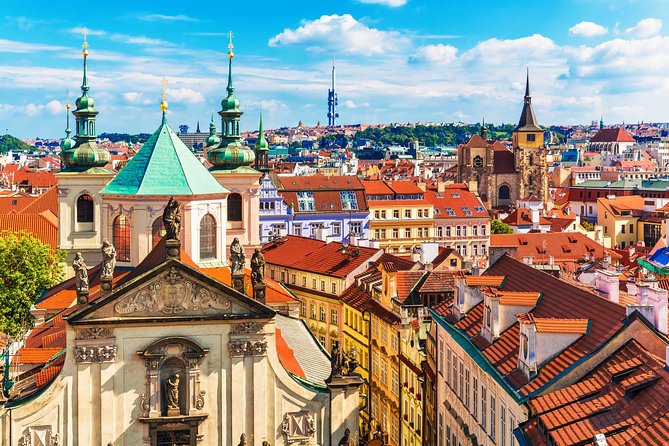
Prague can feel like a beautiful puzzle. The streets curve, stairs appear out of nowhere, and suddenly you’re lost near a church you didn’t plan to see. This tour is designed to stop that chaos. You walk a logical line: starting near the Old Town side, crossing the river at Charles Bridge, then working your way back through the city’s most recognizable layers.
The timing also matters. At roughly 3 hours 30 minutes, you get enough time to understand what you’re looking at, without turning your day into an all-day endurance event. The tour is listed as moderate physical fitness, which to me reads as honest: you should expect a steady walking pace and some uneven ground.
And because it’s private, you’re not stuck watching a guide’s voice disappear into a group. If you ask a question or want a specific vibe, you have a much better chance of getting a real answer and a route that fits.
Start Near Municipal House, Then Let Your Guide Set the Pace
Meet at Náměstí Republiky 5 in Prague 1, Staré Město. If you want the Old Town start instead, you can meet at the entrance to the Municipal House (Obecni dum), next to the Gothic Powder Tower. The day can also begin with pickup at your hotel reception or outside your building, as long as you provide your address when booking.
What I like about this setup is that it reduces the early-day friction. You spend less time hunting for the meeting point and more time turning up ready to walk. The tour also uses a mobile ticket, so you’re not juggling paper confirmations.
One more practical note: because it’s private, use that to your advantage. If you care about architecture over legends, or legends over facts, tell your guide early. Several guides connected to this tour style are praised for tailoring and for mixing history with practical local suggestions, including food and beer recommendations.
More lanes taken at street level:
- Prague: 3-Hour Walking Tour of Old Town & Prague Castle
★ 4.7 · 5,696 reviews - Prague: Ghost Walking Tour Where Legends Come To Life
★ 4.4 · 5,253 reviews - Prague: Jewish Quarter Walking Tour with Admission Tickets
★ 4.7 · 3,729 reviews
Prague Castle Complex: St Vitus, Power, and Views From the Hill
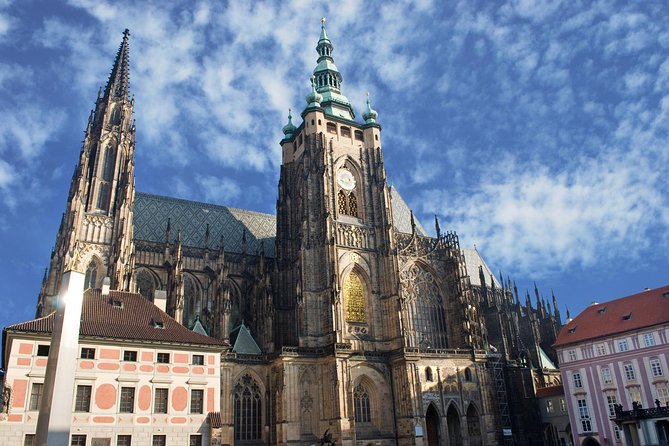
Prague Castle is the reason many people come to Prague twice. From the hill, it dominates the skyline, and even before you go inside, you can feel the scale. The castle complex is also a place of long-term political drama. It was founded in 870 and it’s been tied to the Czech president as the seat of the presidency. It also served as the seat of the Holy Roman Empire under Emperor Charles IV.
In the centuries since, different rulers left different marks. The tour highlights Adolf Hitler’s occupation during darker days, and it also brings in democratic leadership under Tomáš G. Masaryk and Václav Havel. That mix can be heavy, but it also explains why Prague’s stones don’t just look old. They carry decisions.
The centerpiece is Saint Vitus’ Cathedral, described as mostly Gothic and as a project that took around 1,000 years to complete. Expect the guide to point out what makes the cathedral feel both grand and unfinished in a deliberate way. If you want to step into interiors, admission is not included, so you’ll handle any paid tickets on the spot by card.
My advice: give yourself permission to slow down here. If you rush, you miss the point of the place, which is the way different eras stack into one view.
Malá Strana and St Nicholas Church: Baroque Beauty Under the Castle
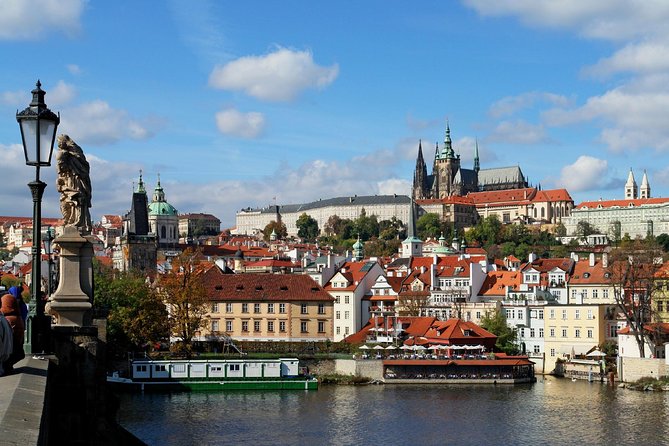
Once you come down from Prague Castle, the vibe changes. Malá Strana, also called the Lesser Quarter, feels more intimate. The tour explains that the area started as small settlements outside castle fortifications, with a population that included ethnic Germans invited by King Přemysl Otakar II.
The centuries include setbacks. The settlement was ravaged by fire in 1419 during a Hussite battle and again in 1541, which also damaged St. Vitus’ Cathedral. Later, in 1257, the settlements were consolidated and a separate royal town formed. You can see the results in the palaces and church-heavy streets.
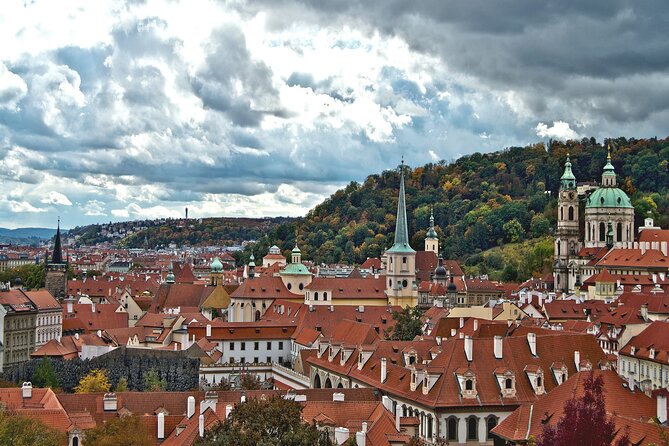
One of the stops is St. Nicholas Church, called the most beautiful Baroque church in Prague and a dominant feature in Malá Strana. The guide also shares a delightful detail: Mozart liked to practise on the organ here because of the excellent acoustics. If you’re even slightly a music person, this is one of those moments that makes a church feel alive instead of just decorative.
This part of the tour is where you’ll appreciate why Prague is famous for walking. Streets drop toward the river, viewpoints open up between buildings, and you get a break from the roar of the biggest tourist corridors.
Also chalked up in Prague




Lennonova zeď: Graffiti That Became a Cultural Footnote
Then the tour does something clever. It gives you a modern Prague landmark that explains the city’s relationship with politics and Western culture.
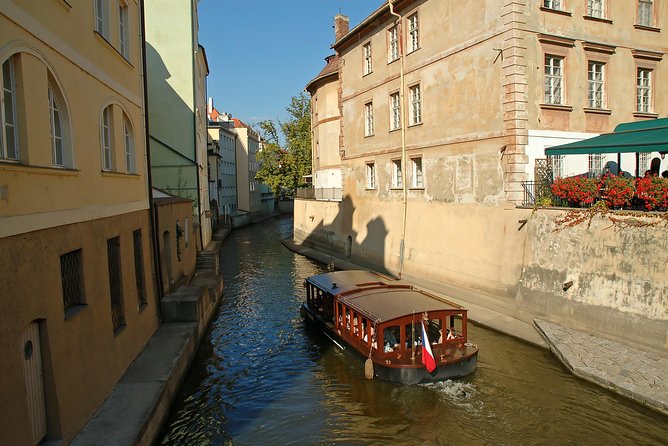
Lennonova zed, the wall covered in graffiti and tribute art, appears in small lanes near the river in Malá Strana. The graffiti started appearing during the Communist era on property belonging to the Knights of the Maltese Cross. When John Lennon died in 1980, local fans responded with a tribute. According to the tour, Western music was banned at the time, and openly showing admiration could lead to imprisonment.
So the art isn’t just street decoration. It’s a story about risk, identity, and how people found ways to express themselves anyway. The stop is short, but it’s one of those pauses that makes the rest of Prague feel more human.
If you’re heading here with your camera ready, keep it respectful. This wall is part artwork, part memory.
Charles Bridge: Legends, Statues, and the Best River Views
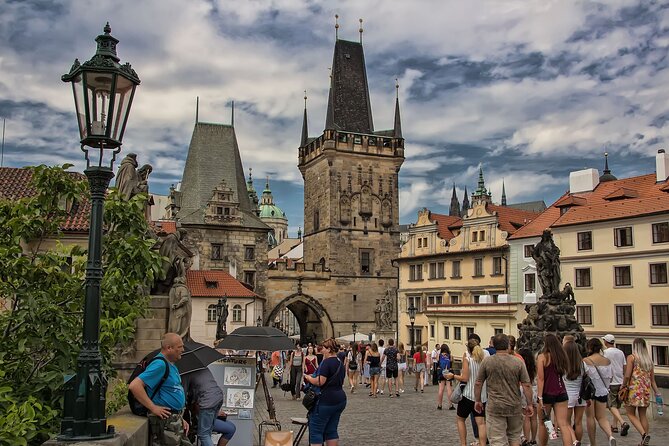
Charles Bridge is often called one of the most beautiful gothic bridges in the world. It connects Old Town to Malá Strana and links toward Prague Castle, so walking it feels like moving through the city’s spine.
The tour notes it was commissioned by King Charles IV, and it points out the famous saintly Baroque statues. There are 30 statues, most made of sandstone and added in the 18th century. Many of the statues you see today are replicas, with an original bronze statue mentioned at the first installation: St. John of Nepomuk.
Here’s the legend the guide brings into focus. St. John of Nepomuk is said to have refused to reveal the confessions of the wife of King Wenceslas IV, then was thrown off the side of the bridge to his death. The tour also explains why you’ll see a five-starred halo above statues of Nepomuk, tied to a story about stars appearing in the sky that night.
You’ll spend about 30 minutes on Charles Bridge, which is a helpful amount of time. Long enough to get photos and walk both sides of your own gaze, not just stand in one spot waiting for crowds to shift.
My practical tip: if you want calmer photos, keep your shots flexible. It never gets totally quiet on Charles Bridge, but a few steps in either direction can change everything.
Klementinum: The Jesuit College and Prague’s Scholarly Side
After the bridge and Malá Strana highlights, the tour turns toward learning. Klementinum is presented as a former Jesuit college, and it’s home to the National Library.
It’s easy to pass a building like this without understanding why it matters. The guide helps connect it to the idea of Prague as a city that collected knowledge, not just wealth. If you like libraries, archives, or the feeling of old learning in a big building, this is a satisfying stop.
Whether you go inside for paid entry is up to you, since admission is not included. But even standing near it, you get that Prague mix of religious architecture, civic importance, and long-term institutions.
Pinkas Synagogue and Old-New Synagogue: Jewish Prague in Two Powerful Stops
The tour includes two Jewish Quarter sites, both heavy and important.
Pinkas Synagogue is described as part of the Jewish Museum. Its walls are covered with names of Jews who perished during World War II. The synagogue also provides entrance to the Old Jewish Cemetery. This is not the kind of place where you move quickly. The guide’s role is crucial here, because a few context points make the names feel grounded instead of overwhelming.
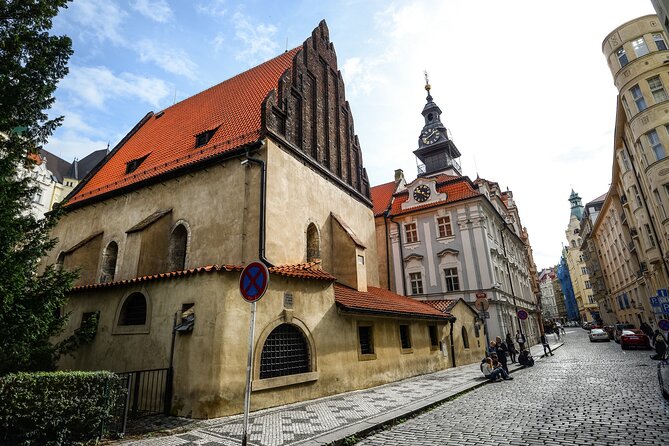
The second stop is the Old-New Synagogue, called the oldest serving synagogue in Europe. It was completed in 1270 and is Gothic in style, which makes it feel unexpectedly old for a building still actively connected to faith today.
This section of the tour is one of the best reasons to book a guide rather than self-walk. You can visit the buildings on your own, but understanding what you’re seeing, and why it’s preserved the way it is, changes the experience.
If you want a day that includes monuments plus meaning, this is where the tour delivers.
Old Town Square and the Astronomical Clock: Prague’s Stage
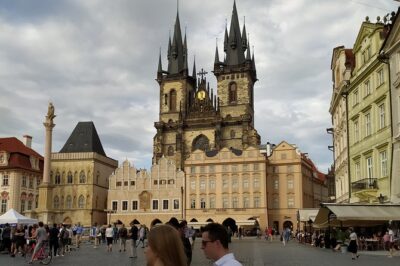
Old Town Square is one of those spaces that feels like it has always been the center of attention. It’s surrounded by ancient palaces and churches, and the tour points out that decisive events of the country took place here.
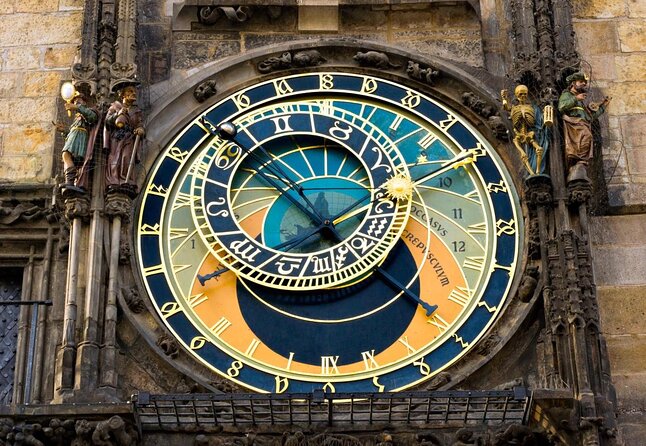
Then you move to the Old Town Hall and its Astronomical Clock. The Old Town Hall was built in 1338 and has a 60-meter tower. On the orange façade, the tour highlights a Renaissance window from 1520 and the inscription Praga Caput Regni, plus the Old Town coat-of-arms.
The Astronomical Clock is the moment people line up for. On the hour, Death tips an hourglass and rings a bell, then the 12 apostles march by, the cock crows, and another bell rings. The stop here is listed at about 10 minutes, which is enough time to see the clock and understand what’s happening without losing your whole afternoon.
My advice: if timing allows, get settled a little before the hourly show. The tour is moving, but you’ll enjoy it more if you’re not scrambling into a standing crowd at the last second.
Estates Theatre, Charles University, and Wenceslas Square in One Flow
From the Old Town anchor, the tour continues into Prague’s ideas-and-events corridor.
At the Estates Theatre, the guide connects Mozart to Prague’s stage history. Mozart enjoyed visiting Prague and chose this theater for the world premiere of his opera Don Giovanni, which he conducted himself in October 1787.
Next is Karolinum, tied to Charles University. Emperor Charles IV founded the university in 1348, making it the oldest university in the Czech Republic and one of the oldest in Europe. That fact matters because it explains why Prague’s intellectual life is not a recent invention.
Then comes Wenceslas Square. The tour explains it was originally called the Horse Market when Charles IV founded the New Town in 1348. In more recent history, it witnessed decisive events like the Velvet Revolution in 1989, which put an end to Communist rule.
This cluster of stops works well because it mixes culture with civic life. You’re not just seeing pretty buildings. You’re seeing how Prague staged change.
Powder Gate and the Municipal House: Gateways to the Medieval Royal Route
To wrap up, you’ll pass by iconic structures that frame Prague’s routes and national identity.
Prasna brana, also called Powder Tower, is described as a Gothic tower that serves as a gateway to the Medieval Royal Route. It’s currently one of Prague’s most recognizable buildings. Even if you’ve seen it in pictures, seeing it in context makes it click as part of a whole plan of movement through the city.
Finally, the Municipal House (Obecni dum) is a strong finish. Built in 1912 at the former Royal Court site, it celebrates the Czech nation. The tour notes the building belongs among Prague’s architectural jewels due to its concert hall and decorations.
This is the kind of stop that feels like a handshake from the guide: the tour started with castle power and ends with national pride and civic culture.
Practical Tips So You Enjoy Every Stop
This is a walking tour, and it’s in historic districts. Here’s how I’d set yourself up for a smooth day.
- Wear shoes you trust. Streets can be uneven, and you’ll be on your feet for hours.
- Plan for optional paid interiors. Admission is not included, so have your card ready in case you decide to go into places.
- Bring your own snacks or expect to skip. Snacks aren’t listed as included.
- Use the guide for choices. If you want more church time or less, say so. If you want a shorter clock stop or extra viewpoint time, ask.
- Skip the stress with transport. One review note I’d take seriously: avoid Prague taxis that can be overpriced. Ride-hailing like Uber is mentioned as cheaper in that context.
And if rain or cold hits, don’t cancel the vibe. Prague still works as a walking city. In bad weather, your guide can also help you adjust the route so you don’t spend the whole day battling the elements.
Who Should Book This Private Tour (and Who Might Skip It)
This tour is ideal if you’re doing Prague for the first time and want a structured walk that still feels personal. It’s also a good pick if you like variety: Prague Castle, Malá Strana, Charles Bridge, Jewish Quarter sites, Old Town Square, and Wenceslas Square are all different enough to keep your brain awake.
It’s especially suited to couples and small groups who want context and local guidance, not just landmarks. If you’re traveling solo, you’ll also appreciate the private format because you can ask questions as they come up instead of waiting for the group.
I’d think twice if you have limited mobility or you know you struggle with long walking on uneven ground. The tour is described for moderate fitness, and that’s honest.
Should You Book It? My Decision Rule
Yes, if you want a first-day overview that doesn’t waste time. The route is built to connect the big Prague icons with stories you’ll remember, and the private guide format is what makes it worth paying for rather than self-walking.
I’d book it without hesitation if you like:
- a clear path through Prague Castle, Malá Strana, Charles Bridge, and Old Town
- cultural context, including the Jewish Quarter stops and the clock legend moments
- a guide who can adjust based on your interests
I’d hesitate if you mainly want short stops and lots of sitting, or if you’re not comfortable walking for several hours. In that case, you might prefer a shorter or less walking-heavy plan.
If you do book, here’s my one practical move: tell your guide what you care about first. The tour works best when your questions and preferences shape the day.
FAQ
How much does the Best of Prague Private Walking Tour cost?
It costs $134.23 per person.
How long is the tour?
The duration is about 3 hours 30 minutes.
Does the tour include hotel pickup?
Yes, pickup is offered at your hotel reception or another location in the city center on foot. You’ll need to provide your address in Prague when booking.
Where is the meeting point?
The start is Náměstí Republiky 5, 111 21 Prague 1, Staré Město, Czechia. If you start in Old Town, you can meet the guide at the entrance to the Municipal House next to the Gothic Powder Tower.
Is the tour private?
Yes, it is a private tour, and only your group participates.
Is the tour in English?
Yes, it is offered in English.
Do I have to pay for admission to places?
Admission is not included. The tour notes that you can pay for admission on the spot by card.
Newly posted under the arches of Prague

Walking Tours, compared.

3-Hour Walking Tour of Old Town & Prague Castle
Read our review →
Ghost Walking Tour Where Legends Come To Life
Read our review →
Jewish Quarter Walking Tour with Admission Tickets
Read our review →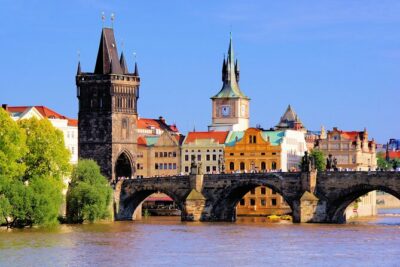
Prague Guided Walking Tour and Cruise with Authentic Czech Lunch
Read our review →
Old Town and Jewish Quarter Guided Walking Tour
Read our review →
Prague Ghost and Legend of Old Town Walking Tour
Read our review →
Prague 3-hour Afternoon Walking Tour including Prague Castle
Read our review →
Ghosts and Legends Nighttime Guided Walking Tour
Read our review →Browse the lists this tour appears in