
Reviewed · WALKING TOURS
Private Prague Art Nouveau and Cubism Walking Tour
Prague turns modern in a three-hour stroll. This private walking tour brings you face-to-face with Prague’s turn-of-the-century Art Nouveau and Cubism, and it teaches you how to read the buildings like a story. I especially love how the guide points out specific design habits, like curvy signage lettering and decorative motifs tied to world influences. I also love the mix of big, famous landmarks and quieter interiors, so you see both the look and the mood of early 1900s Prague. One consideration, it is a lot of walking for 3 hours, so it may not suit mobility-impaired travelers.
You’ll move at a comfortable pace for a focused route, with quick stops (mostly 5 to 15 minutes) and a historian guide doing the talking. In practice, the best part of a private format is that you can ask why a detail exists, not just what it looks like.
In This Review
- Key Things I’d Bookmark Before You Go
- Why Prague’s Art Nouveau and Cubism Make Sense on Foot
- Private Historian Guide: How This Tour Stays Useful After the Walk
- Price and Value: What You’re Really Paying For
- Stop 1: House of the Black Madonna, Cubist Drama in Stone
- Stop 2: Obecní dům, the Icon of Czech Art Nouveau
- Stops 3 to 4: K+K Hotel Central Prague and Café Imperial
- Stop 5: Czechoslovak Legion Bank, Cubist Architecture with a Purpose
- Stop 6: Prague Main Train Station, the Art Nouveau Dome Moment
- Stops 7 to 9: Wenceslas Square, Lucerna Arcade, and the Upside-Down Statue
- Walking Time and Comfort: Plan for Legs, Not Just Looks
- The Best Way to Get More From This Tour
- Should You Book This Art Nouveau and Cubism Walking Tour?
- FAQ
- How long is the Private Prague Art Nouveau and Cubism Walking Tour?
- Is this tour private, and how many people can join?
- What language is the tour offered in?
- Is pickup included?
- Where does the tour start?
- Are there admission fees at the stops?
Key Things I’d Bookmark Before You Go
- Design-reading, not sightseeing: you learn what to notice on façades, signs, and interiors, including decorative themes and style cues.
- A strong split between movements: you cover Cubism at places like the House of the Black Madonna, then pivot to Art Nouveau’s optimism and flair.
- Interiors included in the story: Café Imperial, Lucerna Arcade, and Prague Main Station’s dramatic interior dome get attention beyond the outside view.
- Landmarks with easy timing: each listed stop is free to visit, so you spend time learning instead of queuing for tickets.
- The Lucerna area is a highlight: the tour connects Lucerna’s modern-era venues to wider Czech cultural momentum.
- A guide who brings context: guides such as Robert Wesley and Bonita are praised for weaving architecture with personal and cultural storytelling.
Why Prague’s Art Nouveau and Cubism Make Sense on Foot
Prague is famous for Gothic and Renaissance landmarks, but it has a modern side too, especially around the late 1800s and early 1900s. That is when architects and designers started treating buildings like a canvas for new ideas. Walking is the only way to understand that shift, because so many Art Nouveau details are meant to be noticed close up, at eye level, and often in passing.
What I like about this tour is that it does not treat style as a museum label. You get practical visual lessons. For example, you’re not only told that Art Nouveau uses ornament, you’re coached to spot the specific habits, like ornate light fixtures, curving typography on signs, and recurring natural shapes with surprising influences. The goal is simple: once you learn the pattern, you can see it anywhere you stand in Prague after the tour.
Private Historian Guide: How This Tour Stays Useful After the Walk
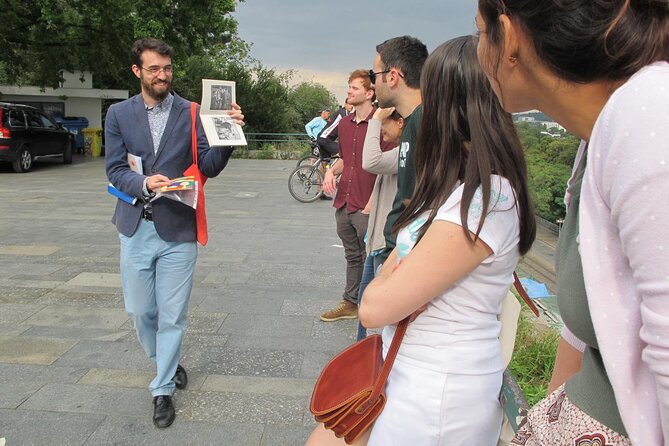
You book this as a private tour for up to 10 people, so you’re not competing with a large group for the guide’s attention. That matters for this topic because architecture trivia is only half the point. The other half is learning how to look.
A big strength here is that the guide is described as a historian guide, and that shows in how stories connect design to the time period. In examples from past departures, guides like Robert Wesley (described as Czech born with a Nigerian father) and Bonita are praised for linking history, culture, art, and architecture into a single thread. That is exactly what you want on a walking tour of styles, because Art Nouveau and Cubism are not just aesthetics. They are also signals of Czech ambition, European curiosity, and shifting identity.
Also, you get a mobile ticket, and the tour runs in English. That keeps the experience straightforward, especially if you’re hopping between multiple days of sightseeing.
More lanes taken at street level:
- Prague: 3-Hour Walking Tour of Old Town & Prague Castle
★ 4.7 · 5,696 reviews - Prague: Ghost Walking Tour Where Legends Come To Life
★ 4.4 · 5,253 reviews - Prague: Jewish Quarter Walking Tour with Admission Tickets
★ 4.7 · 3,729 reviews
Price and Value: What You’re Really Paying For
The price is listed as $396.46 per group (up to 10 people). Private tours can feel pricey until you do the math for your own group size. If you come with 2 people, the cost per person is high. If you come with 8 to 10 people, the cost per person drops a lot and starts to feel like a smart way to buy expertise.
Here’s what you’re paying for, beyond the walking itself:
- A historian guide who helps you understand the style cues.
- A tight route with nine stops, keeping you from spending your limited energy figuring out what to see.
- Listed stops with free admission, so you avoid extra ticket costs and time drains.
If your group is small, consider whether you’re the type of traveler who enjoys “spot the detail” experiences. If you are, you’ll get more from this than a generic overview tour. If you just want iconic photos fast, you may prefer a shorter, more landmark-heavy route.
Stop 1: House of the Black Madonna, Cubist Drama in Stone
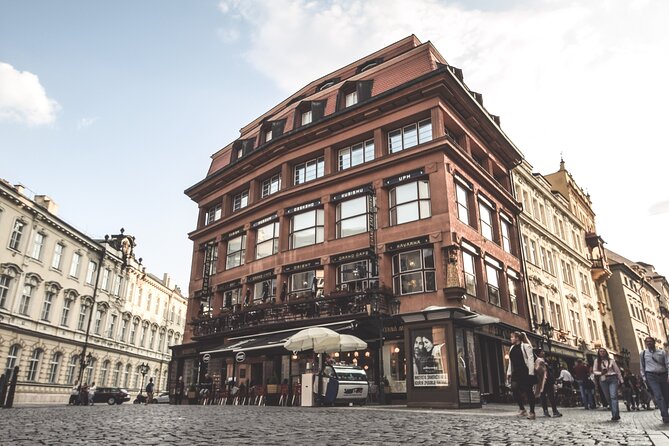
The tour starts at the House of the Black Madonna, known for its Cubist style. Cubism in Prague is not something you stumble into by accident, and that is the benefit of getting it early. You immediately set your brain in “how to recognize forms” mode.
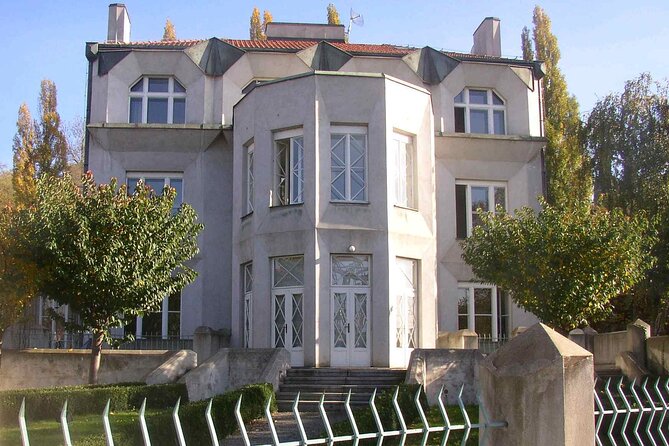
At this first stop, the guide’s job is to help you see how Cubism breaks from smoother, more traditional lines. Even if you do not remember every art term, you’ll likely remember the feeling: sharp geometry, a sense of structure forced into a new shape, and a visual language that feels modern for its era.
Why this stop is worth the quick time: it gives context for everything that comes next. When you later see Art Nouveau’s curving elegance, you’ll notice the contrast even more clearly.
Also chalked up in Prague
Stop 2: Obecní dům, the Icon of Czech Art Nouveau
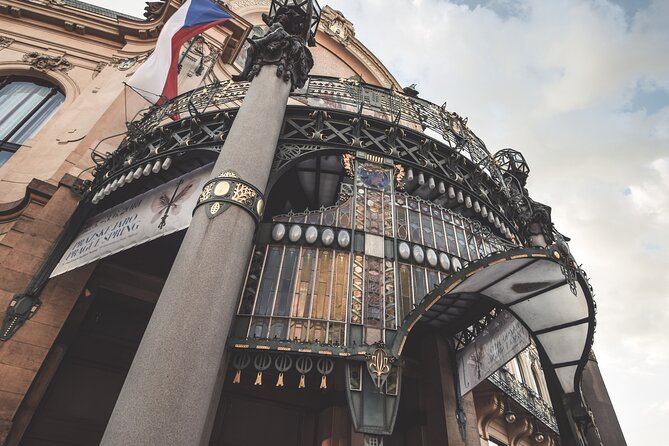
Obecní dům is one of the most iconic examples of Czech Art Nouveau architecture, and it works well as your second stop because the tour shifts from Cubist edge to Art Nouveau flourish.
This is where you start to understand the “signature look” of the style in a practical way. The point is not just to admire a façade. The guide helps you connect ornament to purpose. Art Nouveau often tries to make buildings feel alive, almost like they have motion, and that shows in decorative patterns and the way elements are arranged.
A small drawback to keep in mind: iconic exteriors are sometimes surrounded by regular street life, so you’ll want to pay attention when the guide calls out details rather than relying on the crowd to create good viewing angles.
Stops 3 to 4: K+K Hotel Central Prague and Café Imperial
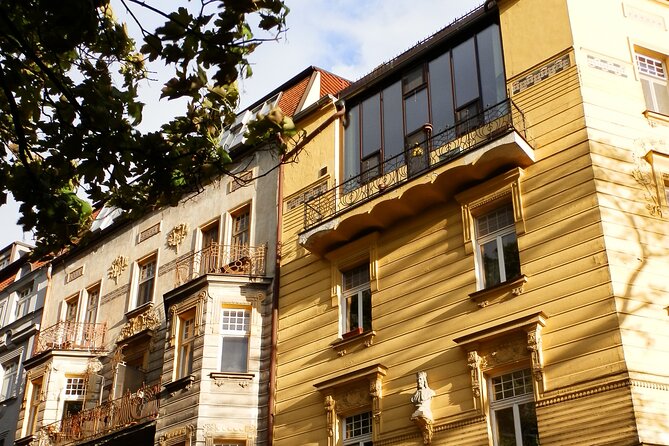
These two stops are about experiencing Art Nouveau as an atmosphere, not just a design style.
K+K Hotel Central Prague is described as the first Art Nouveau building in Prague, and that alone makes it a key moment on the route. The tour frames it as part of a wave of optimism at the turn of the 20th century, when Czech culture was ready to join broader European avant-garde trends. That context changes how you see the architecture. You are no longer looking at pretty lines only, you’re looking at a public statement.
Then Café Imperial brings it inside. The interior is unique, and the time is short. That means you should use your minute well: focus on how the interior’s look supports the feeling of modern leisure, and notice how decoration guides your attention.
If you care about interior design, you will appreciate this part more than a photo-only approach. If you feel rushed easily, the 5-minute timing at Café Imperial may feel brief. That is why the guide’s pointing out what matters helps so much.
Stop 5: Czechoslovak Legion Bank, Cubist Architecture with a Purpose
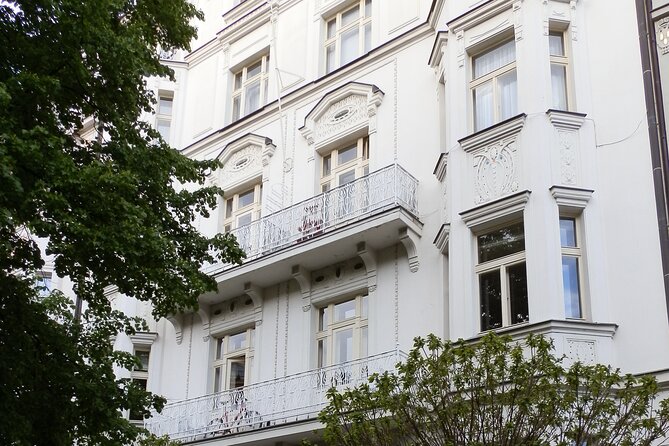
The Czechoslovak Legion Bank is a strong stop because it ties architecture to a specific story, one connected to World War I through the Czechoslovak Legion of the 1st World War.
This is where Cubism moves beyond “form for form’s sake.” The building and interior dedication give the style a historical job to do. The tour helps you connect that to national sentiment and memory, which is valuable because it prevents Cubism from feeling abstract.
Practical advice here: take a moment to look for how the space feels intentional. Even if you do not have time for full reading, the symbolism becomes easier to grasp when you remember that these buildings were designed to communicate identity.
Stop 6: Prague Main Train Station, the Art Nouveau Dome Moment
Prague hlavní nadrazi gives you a dramatic interior moment, including the magnificent interior Art Nouveau dome. Stations can be chaotic places, but this stop is the opposite of a rushed transit experience, because the tour focuses on architectural impact.
Why this stop lands: the dome is a visible sign that Art Nouveau was not limited to cafés and decorative buildings. It also entered civic life, shaping how people moved through important public spaces.
A quick caution: train stations can be visually busy. Your best strategy is to follow the guide’s cues. If you try to enjoy it as a free-for-all, you may miss the most relevant architectural features.
Stops 7 to 9: Wenceslas Square, Lucerna Arcade, and the Upside-Down Statue
This final stretch is where the tour’s cultural storytelling really clicks.
Wenceslas Square is the setting for a discussion of Art Nouveau and Art Deco architecture. That matters because it shows how styles evolve in the same city grid and social space. You start seeing time layers in one view, which is exactly what you want in Prague.
Then comes Lucerna Arcade, described as having the Art Nouveau interior of the most beautiful arcades of Prague. The tour also connects this area to the Lucerna Bar, once owned by Vaclav Havel’s family. That link adds emotional depth. It frames these spaces as more than decorative corridors, they are part of Czech modern life and cultural memory.
Finally, the tour addresses the Upside-Down Statue of King Wenceslas riding a dead horse, with symbolism explained in the context of Czech history and the Czech National Revival. This is one of those moments where a sculpture becomes a conversation about national identity, change, and sometimes criticism. If you like interpretive history, this stop is a highlight.
A practical note: the last stops are close enough to keep momentum, but you still want comfortable shoes. By then, your legs will be the real limiting factor, not your interest.
Walking Time and Comfort: Plan for Legs, Not Just Looks
The tour is about 3 hours long and includes a lot of walking. Stops are short, but you do cover ground. That means it is not a “sit and watch” tour.
I recommend it if you are comfortable doing a steady urban walk and you like stopping to look closely. I would be cautious if you have limited mobility. One guide example and the tour details both point to the walking nature as something to consider.
If you’re bringing a camera or phone, you’ll do best by using your photo time right after the guide points out the detail. That way you’re capturing what you actually learned, not just what you noticed first.
The Best Way to Get More From This Tour
Here are a few habits that make this type of architecture tour pay off fast:
- Use the guide’s prompts to train your eye. Once you learn what to look for, you’ll spot Art Nouveau motifs for the rest of your trip.
- Pay attention to signage and fixtures. The tour explicitly focuses on things like curvy typography on signs and decorative motifs tied to oriental influences, such as gingko biloba leaves.
- Keep an eye on contrasts. The route intentionally moves between Cubism and Art Nouveau, so compare how the buildings feel when you stand in front of them.
If you do this, you’ll leave with more than photos. You’ll leave with a mental checklist.
Should You Book This Art Nouveau and Cubism Walking Tour?
Book it if you want a private, guided architecture experience with a historian’s explanations and you enjoy close-up details. This tour is especially good for people who like art when it is grounded in real places, real eras, and real symbolism.
I would skip or swap to something else if you:
- Need very limited walking time.
- Prefer only the largest, most obvious landmarks with minimal stop-and-explain.
If your group size is on the higher end (up to 10), the $396.46 per group pricing starts to look like strong value for a specialized topic. And if you’re traveling in a smaller group, it’s still worth considering if you truly like learning to see.
FAQ
How long is the Private Prague Art Nouveau and Cubism Walking Tour?
It lasts about 3 hours.
Is this tour private, and how many people can join?
Yes, it is private. Only your group participates, with up to 10 people.
What language is the tour offered in?
The tour is offered in English.
Is pickup included?
Pickup is offered, but hotel pickup and drop-off are not included. If hotel pickup is not arranged, you meet the guide 15 minutes before start time at the default location.
Where does the tour start?
Unless hotel pick up has been arranged, meet at Grand Cafe Orient, Ovocný trh 19 Prague 1.
Are there admission fees at the stops?
The itinerary lists admission ticket free for the stops.
Newly posted under the arches of Prague

Walking Tours, compared.
3-Hour Walking Tour of Old Town & Prague Castle
Read our review →
Ghost Walking Tour Where Legends Come To Life
Read our review →
Jewish Quarter Walking Tour with Admission Tickets
Read our review →
Prague Guided Walking Tour and Cruise with Authentic Czech Lunch
Read our review →
Old Town and Jewish Quarter Guided Walking Tour
Read our review →
Prague Ghost and Legend of Old Town Walking Tour
Read our review →
Prague 3-hour Afternoon Walking Tour including Prague Castle
Read our review →
Ghosts and Legends Nighttime Guided Walking Tour
Read our review →Browse the lists this tour appears in